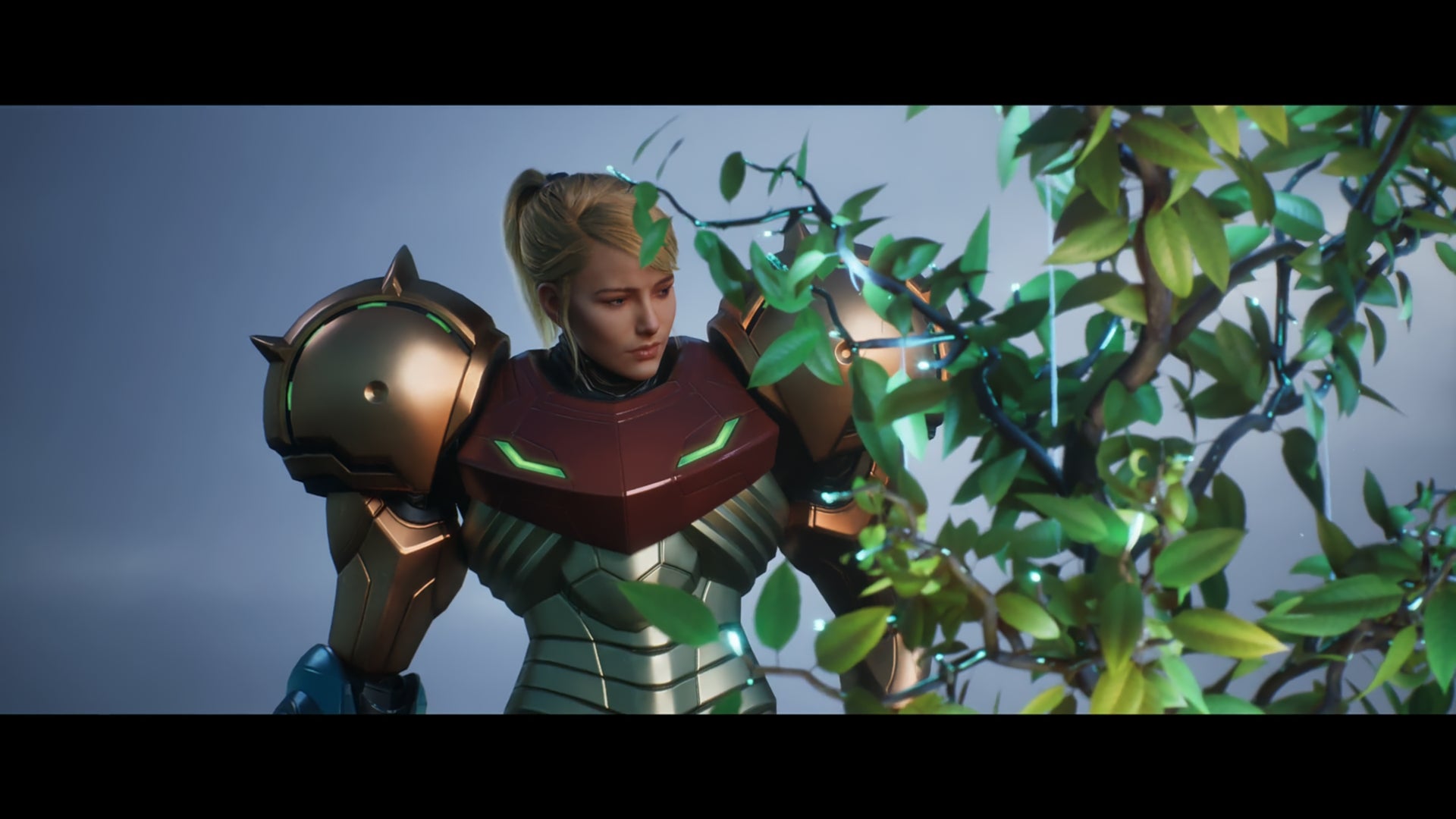
Metroid Prime 4: Beyond Review

Beyond is a Nintendo game through and through, but its Metroid bits are on another planet entirely…

When your namesake is one part of a very popular genre title, you’re kind of a big deal. Metroid Prime 4: Beyond, however, might be one of the least ‘Metroidy’ Samus Aran adventures, ever. In fact, we’d go as far as to suggest Beyond has more in common with The Legend of Zelda: Ocarina of Time than any of the Primes before it. From its Hyrule Field and Epona moment to its *masked* dungeons and magic keys collection quest, Beyond is as much Link-fueled fantasy as it is galactic bounty hunter-ing in a sci-fi world, to the point it feels like it’s almost lying to itself. It removes Samus’ trademark isolation in place of ‘helpful’ NPCs to collect (not unlike the gathered Sages of most Zelda jaunts), while its key biomes are no longer tightly intertwined spaces of brilliantly designed levels, rather, they’re now presented as standalone places of interest spread (not so) far and wide, all connected by perhaps the most barren of overworlds encountered in any game of this scale, let alone legacy.

It’s not that all of the above is overtly bad, it’s just that at its heart Beyond goes beyond any sort of Metroid design philosophies and instead presents more classically NIntendo than anything else, and we’re still not sure if that’s a good or bad thing.

We mean, this could have been a Zelda or a Mario or even a Kirby. Its identity just feels… off.

What we do know is that on the surface Beyond tells us a handful of things Metroid should never be, if this modern-but-classic design tilt is to be followed in any Primes in the future. And that’s about as good a place to start this review proper, because there’s quite a bit to unpack and quite a lot missing from a game (and game style) that has, for all intents and purposes, been in development for the better part of six-plus years...

Metroid Prime 4: Beyond

Genre: First-Person Adventure
Developer: Retro Studios
Publisher: Nintendo
Release Date: December 4, 2025
Classification: PG
Date: December 10, 2025

Ep-0-na the Chopper-Shaped Camel

The first time you encounter Hyrule Field in Ocarina of Time is a moment of pure magic. Particularly if you played that game when it actually released way back in 1998 because no 3D game back then had ever presented such an ‘enormous’ space before the player. And then, learning that it was the launching point for all of the game’s other locations; an overworld of sorts, but embedded in the live experience, rather than somewhere you whisk in and out of (as had always been the case), well… it just changed everything

"Metroid Prime 4: Beyond attempts to do this in a Samus-starring sci-fi setting, and it falls very, very flat..."

Adding Epona to that was Nintendo’s next moment of brilliance and we’ve collectively, as an industry, never looked back -- just go and fire up OoT again and breathe in that simple yet majestic intro sequence and try not see the subtle genius of what The Big N was doing back then.

Metroid Prime 4: Beyond attempts to do this in a Samus-starring sci-fi setting, and it falls very, very flat. Her new world is one she’s not of, but destined to impact and change, just like Link. It's a larger space meaning she needs to traverse its huge Sol Valley desert -- an expanse of literal dunes and rock with just a handful of jutting and 'hidden' points of interest, that connects it all, but first she needs to enter the Volt Forge. From inside here we start to feel like this is Metroid of old; it’s a stunning, electrically-charged area too. It’s just that, similarly to having to race Epona at Lon Lon Ranch in order to achieve your mount in OoT, Beyond suddenly gives us an F-Zero-inspired ‘bike license’ course in order to achieve Vi-0-la, immediately breaking that "Metroid of old" sentiment and from here on out, what is traditionally presented as an intimate, isolating adventure of discovery and alien horrors with some lite archaeology and lessons in locational terrestrial science, becomes a rigid, arcadey and, dare we say it… silly take on things. It’s not always like this, but when it has the opportunity to flick the figurative morph ball off the track, it does, and does so unapologetically.

Would you like to know more?
All preview concerns over the NPCs were, largely, warranted. This 'rag-tag' group couldn't be more trope-laden, but their collective dialogue and interactions with both the world and Samus are always at odds, making them even harder to swallow. In the space of two minutes we had Mackenzie reminding us to "go revisit" areas now that we had new abilities and when ignored, he forced the map upon us and told us where to go next - a directive that is entirely at odds with traditional Metroid design and, you know, challenge. They honestly bring very little to the whole affair and if we had our way, the Galactic Federation just wouldn't exist - we'd muster a far more sinister organisation with blurred lines and even blurrier objectives for our, you know, BOUNTY HUNTER, to work with. Or, she'd just work alone for a shadow syndicate or some other unknown entity. The fact Retro and Nintendo, this time around, are seemingly making Samus a “Master Chief”-like is… alarming.

Ice Beltscapade

From that moment above, the game continually dips in and out of excellent and classic Metroid bits, fusing those with handholdy annoyances, contextual-less magic and some of the most awkward writing this series has presented, ever. In “Fury Green” we get a taste of this fusion, which at least readies us for what’s to come and as a tutorial level, that’s almost kind of fine. But when we get to “Ice Belt”, we’re in a visual and tonal meld of Alien(s), The Thing and Dead Space, wrapped in traditional and familiar Metroid design. It’s awesome, and made all the more menacing because of the snow wolves you meet just on your way into the joint. But it turns out even they’re just a set-dressing reason to serve us up our second NPC encounter by way of Corporal Reger Tokabi, and that new design tilt jolts things out of sync, again. (He’s far less annoying than Miles Mackenzie though, but still has his moments -- read our “Would you like to know more?” box out for… MORE!)

"When Beyond is a functioning and carefully engineered world with reason and alien logic central to its overall society and existence, it’s excellent..."

The whole of Ice Belt, for ours, was the best part of Beyond by leaps and bounds and should stand as a reminder for what this series can deliver. But it’s also an incredibly easy ‘dungeon’, and even its Griever baddies -- aggressive sharp-clawed puppies with a unique backstory we won’t spoil in case the game’s less-than-mid story still interests you -- are just so trivial to dispatch they can become annoying, despite looking cool and menacing. Instead, the tale of Ice Belt’s powered down lab now half frozen, the experiments the Lamorn were doing there and its genuine scale help us want to keep pushing through. Puzzles here are less involved than those in “Flare Pool” but they make more contextual sense to the environment and your goal to power it all back up.

There’s growth to achieving most goals in the game, too. Which keeps the scanning hot and heavy, but also goes a long way to simply elevating all of its other annoyances -- when Beyond is a functioning and carefully engineered world with reason and alien logic central to its overall society and existence, it’s excellent. But it attempts to recreate the Chozo race for a new generation through the Lamorn, unnecessarily, which also invites all the other “Chosen One” and ‘child of destiny’ stuff this series just doesn’t always need. Top this with the sycophantic dialogue of essentially every NPC, even the robot, and what could have been a wonderful, exploratory jaunt on an alien world with a villain worth learning more about; allowing us to see the more human and bounty hunter (read: gritty) side of Samus, simply winds up constantly teetering on cringe

Would you like to know more?
Magic "Great Trees" have existed before, even beyond Zelda - Yggdrasil, from Viking culture and mythology, for example. Problematically, we see a cadence unfurl from the Lamorn's version of the Great Deku Tree that is this game reaching for as many themes and philosophies and abstract ideas as possible, but all that's used to connect them is a form of magic or 'psychic energy', but that's also barely explored; gameplay-made-narrative. There's nothing wrong with exploring these things or using any of it from an allegorical perspective, but you need a cohesive and homogeneous spin on it all, and Beyond fails on that front. The promise and tease is there, it just never fully delivers.

Grand Nationals of Sandcastle Building 

Part of our formulation for the above is the game’s disparate visuals. In tight, it's stunning -- more Metroid (and Nintendo) of this visual quality, please. While from afar the scale of things is also to be applauded -- large and in charge, even when it is tricking the eye. But the desert kills all of that hard work, as does the physical space between each and every location, disallowing any meaningful connection between them. We know it makes more sense to have these as contextually separated, but Metroid has never been an ‘open-world’ experience, which it feels like it’s trying to be here.

And fails miserably at, if that was the goal (it was). 

"Except, they all wind up being hidden behind masks, which is an anti-flex from a visual perspective in our books, and could even be an observation-based metaphor for the game as a whole..."

As such, Sol Valley is entirely uninspiring, as is anything design-wise to do with the Galactic Federation outside of their faces which, for a Nintendo game featuring actual humans, present incredibly well. Except, they all wind up being hidden behind masks, which is an anti-flex from a visual perspective in our books, and could even be an observation-based metaphor for the game as a whole -- brilliant in parts, but masked behind some otherwise not-so-great elements in others… but we digress.

The game’s lighting, animations (when not on Vi-0-la) and intricately designed interiors are generally always very good. In Ice Belt, as spoken about above, even powering on the place marks a significant visual change in the environment, and for the better. The other three major ‘dungeons’, however, don’t fare as well. There’s even a hint at a calamity causing the desert to be what it is, with an opportunity to breathe new life into it that goes narratively unfulfilled. It would have been a glaring trope, but it would have been welcome. Sol Valley is the same every single time you ride across it, with the only major changes being that the game’s odd forever collectible -- green crystal shards needed to grow a fruit from Beyond’s version of a Great Deku Tree (see, more Zelda -- read our second “Would you like to know more?” box out for… MORE!), dry up and become clear crystals. Night and day, dynamic weather, shifting sands… anything would have helped bring the space alive, but it’s there and glaring and an honest eyesore in a series that, generation-upon-generation, strives to look and play better.

We can’t stress enough how antithetical to “Metroid” as both a design statement and benchmark for art-direction, Sol Valley is. It almost solely destroys the experience.

Circular Logic

The above stands out so much though, because as stated earlier when Beyond sings, it’s fantastic. A greater emphasis on morph ball aspects with new abilities to tackle both bosses and puzzles is genuinely awesome, very well thought out and contextualised. As is combat -- when it matters. Ice Belt might be our favourite biome, but in the "Great Mines" we get to exercise restraint and power all in one. Grievers here have developed the ability to hear better than their brethren elsewhere on Viewros, meaning using anything concussive will call in more of them. Mobs in Beyond are aggressive. They’re easy, but you can quickly get overwhelmed and lose stacks of health if you’re not on your toes. Again, dual-analogue control with a Pro Controller coupled with Retro’s fantastic lock-on strafe system here is a joy to play with, and while we dabbled in both mouse and Joy-Con setups, that was by far our favourite way to play. And it’s fast.

"You could always just make combat more dynamic, less repetitive and maintain the more traditional Metroid exploration and progression formula, all of which is here, just in small or inconsistent doses..."

The Great Mines also house the game’s most aggressive sub-boss-turned-regular respawner, the Maul Griever Brute. It’s not a particularly hard enemy, but it’s large, takes up a lot of real-estate and is also fast. It also eats through Samus’ ammunition, so you’ll be kept on your toes anyway. Combat doesn’t ever really become overbearing, but the frenetic nature of it helps make the game feel more challenging -- not too unlike the X-Ray moments in OG Prime with Space Pirates in the "Phendrana Drifts", or essentially any of the "Dark Aether" skirmishes from Prime 2. This helps make us feel that, as a shooter, there’s room to advance Metroid in other ways that aren’t open-world or Zelda-ish, if Nintendo is looking for a new hook (or grapple point). But you could always just make combat more dynamic, less repetitive and maintain the more traditional Metroid exploration and progression formula, all of which is here, just in small or inconsistent doses.

Bosses in Beyond are also a mixed affair. Too many of them are drawn out, waiting for a phase shift after firing x-amount of shots during what is normally an ‘impervious’ segment. These tend to lead to short windows you need to try and take advantage of, but lack any sense of dynamism around -- being able to force or laterally think about opening those windows would be a much more rewarding approach for the player. Metroid games are stacked with systems, but rarely can those systems be stacked in ways that exploit the game enough (we know there are “sequence breaks” traditionally found, but we’d like more purpose-designed freedom to utilise the arsenal and abilities we spend so much time otherwise collecting). The bosses were all creative and enjoyable, but a little too paint-by-numbers for ours.

Would you like to know more?
The Sylux predicament. Many reviewers and fans have lambasted Sylux for being a boring boss and even less interesting big bad, but his past with Samus is teased throughout the experience via flashbacks she keeps having. When Sylux emerges in the endgame, he's connected to Lamorn tech asking the question: has he been feeding Samus these flashbacks via Viewros' psychic energy all along? And if so, why wasn't this, and his troubled relationship with Samus, explored further? He's no Ridley, but there's room there to grow out his hatred of Samus and therefore his overall drive... we think he actually has chops as a main baddie.

Raze Ground or Plant Seeds?

By now it might read that we don’t like this game, but we need to caveat the above with the benchmark for which Metroid Prime 4: Beyond is being graded -- Prime, Prime 2 and even Corruption, as well as DREAD, in the modern sense, while not forgetting all other brilliant 2D entries prior. Those are all very big Psychic Boots to fill. It’s not a bad game. In fact, in many respects, it’s a great game. But as an entry in the great Chozo wall-sculpted annals of the Metroid series, it is among the poorer representations. It’s stunning, and features almost all of the great art-direction we’ve come to not just love of the series, but from Retro, specifically. But it’s wishy-washy and poorly written. It’s annoying and choreish. It’s handholdy and lacks depth. It’s repetitive for all the wrong reasons and in all the wrong parts and it's very, very dull in the area it needs to be most dynamic -- Sol Valley.

"At its core Metroid just isn’t an open-world game. At least, not like this..."

It’s a tough spot to be in sometimes, as a reviewer. OG Prime forever sits in this writer’s Top Five. But Beyond is simply something else, and even with an objective mask on, it fails to live up to the legacy or blueprint of the so-called "Metroidvania" its design principals and titular self are eponymous for. 

If Retro and Nintendo wanted to test the waters with this series in new ways, as per our opening salvo, at its core Metroid just isn’t an open-world game. At least, not like this. There’s room to explore more based on a handful of excellent additions to Beyond, but by and large Metroid is defined as an isolating, exploratory near-horror experience. It is a thinking person’s puzzler with twisting, winding pathways and myriad secrets. Its upgrades are never one-note and always expand the overall adventure and, most importantly, it is always a joy to move through. Beyond isn’t any of those things in a triumphant manner, and when any of them are there, it winds up feeling fleeting. 

Don’t get us wrong, this is a stunning Nintendo adventure for the most part and will help usher Switch 2 and Retro (and Ninty) into modernity in exciting ways, and as a standalone title without those giant Psychic Boots to fill, it’s otherwise actually very good. It’s just not the Metroid Prime experience we were looking for, and not the Metroid design expansion we feel the series has ever needed.

What’s Boss?

  • The best visual representation of Samus' world yet (outside of Sol Valley)
  • Great animations and lighting and effects throughout
  • When traditional Metroid atmosphere is at play, it's glorious
  • Excellent shooter mechanics and controls at a consistent frame-rate
  • Aggressive enemies who attack in abundance add to frenetic play
  • An emphasis on expanded morph ball moments and puzzles
  • Excellent soundtrack

Not Boss Enough?

  • Sol Valley is a vacuous space devoid of any life
  • The lack of any weather or time dynamism is at odds with the game's more 'open' approach
  • NPCs are poorly written and even more poorly implemented
  • Far too handholdy with no option to simply work things out for yourself
  • Vi-0-la isn't all Nintendo hyped it up to be and is more a means to a traversal end
  • Bosses, while creative and visually striking, become too tedious and lack any option for dynamic combat, instead relying too heavily on phases
  • Tokabi's 'campfire' moments are genuinely very cringey

Samus returns in her latest adventure on a planet unknown to her. With five keys to find, a desert to ride across on her new space chopper and plenty of things to scan, Metroid Prime 4: Beyond is Retro and Nintendo 'mixing' things up in the world of Samus...

About the Author

Written By Stephen Farrelly
Stephen Farrelly is a veteran journalist and editor with more than two decades experience in the worlds of gaming, entertainment, lifestyle and sport. He is a proud pug dad, loves art in all forms (particularly street and tattoo culture), and is the director of Swear Jar Editorial and Media Pty Ltd, this site's owner and publisher. When not dispensing words, he's also dispensing boutique beers as a taproom fixture at Bracket Brewing in Marrickville, NSW...

Explore More in Gaming

Comment

Please note, comments need to be approved before they are published.