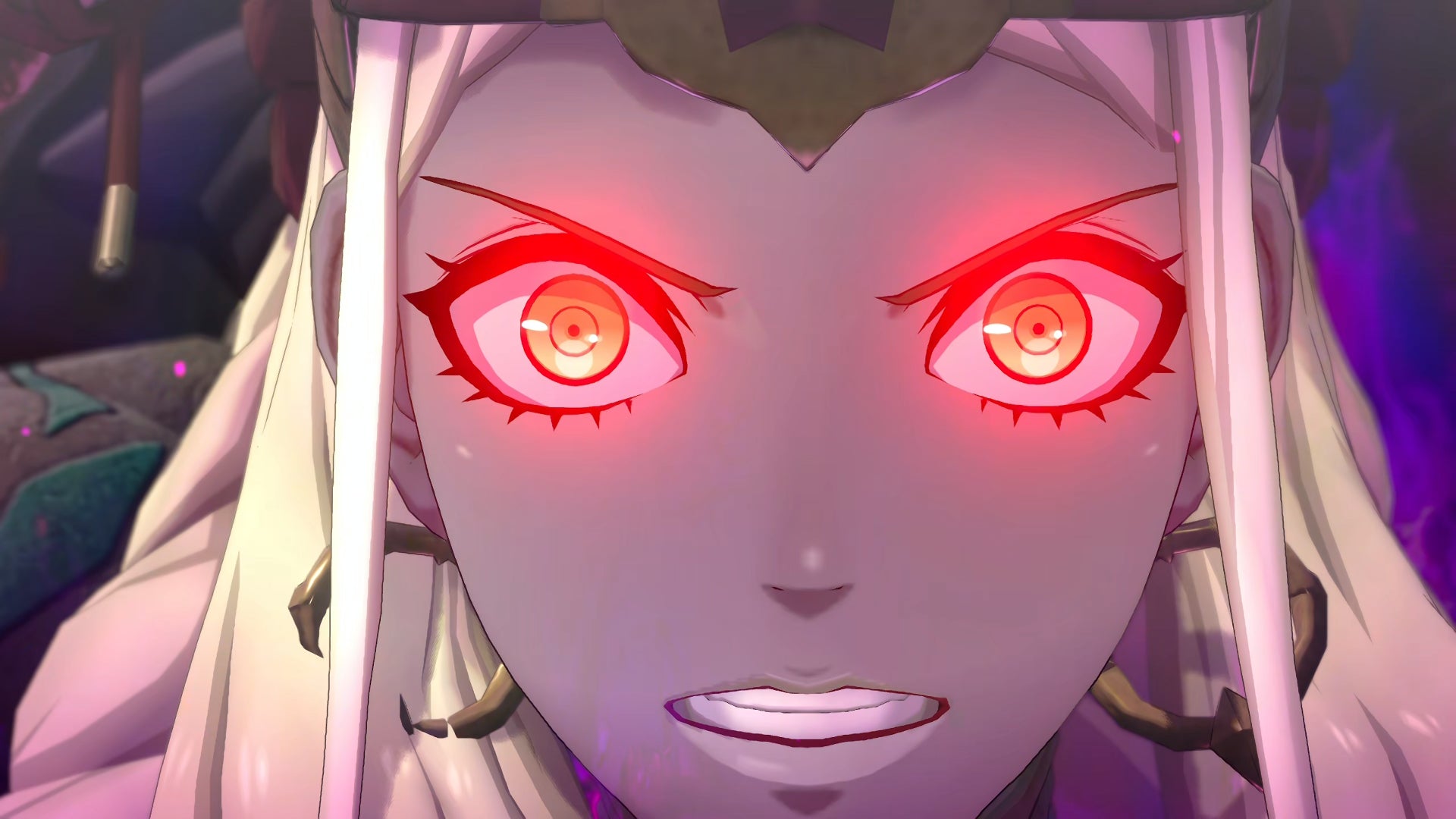
Fire Emblem: Fortune’s Weave Review

Time truly isn’t on your side…

Expect to be sunk when you play Fire Emblem: Fortune’s Weave. This site has had the game since launch and in that time, spent close to 80 hours in its extensive campaign, which involves the lives -- and fates -- of four characters. That’s also outside of you, the player character, who exists in a *sort of* limbo between storylines as a bird, though you make up the game’s prologue and its eventual climax, which can’t rightly be referred to as an epilogue because, it’s also just too big a deal.

None of this is bad, of course, though it can be tedious and repetitive in parts, as well as vacuous in others, but on the whole you get an absolutely massive story here, full of nuance and verve, as well as hugely memorable characters. It’s a slow burn, in the traditional JRPG setup space, and some of its foundations are ‘out there’ early, but once you get a groove and fully understand the poly marriage between post-apocalyptia, sci-fi and feudalistic-esque narratives, it actually comes together fairly homogeneously.

But it is a lot to take in, early.

Still, the core of the Fire Emblem experience is in its tactics-based gameplay loop, and outside of this writer’s personal favourite in Path of Radiance from the GameCube era, Fortune’s Weave is hands down the best entry in the series yet. Fresh concepts, genre-bucking gameplay and an economy around time and investment that is more involved than our tax agent at the end of financial year await you in this ultra-layered story from unique, dovetailing perspectives, with an incredible soundtrack, excellent writing and stunning visuals.

Let’s start the day...

Fire Emblem: Fortune's Weave

Genre: Tactics Turn-Based JRPG
Developer: Intelligent Systems
Publisher: Nintendo
Release Date: September 17, 2026
Classification: M15+
Date: November 13, 2026

Time is a River (Full of Trout)

As mentioned in our opening salvo, Fortune’s Weave is a bit of a time-sink, which involves time itself. It’s also a pretty whacky narrative setup overall. A calamity has struck a future you have one chance at changing, and it’s a future no one but the big bads want -- you know, decay, destruction and the absolute subjugation of all of living kind to the purest of evils… that kind of thing. You are a vessel, naturally, put together on a spaceship of some kind by a also *kind of* scientist and suddenly a game about gods and deities is also a sci-fi with lasers set in a post-apocalyptic landscape and it all gets a bit odd.

"The stronger the bond, the better off your chances will be..."

After a murky intro, however, we get a small taste of exploration and the game’s disparate loops before we get to travel back in time and take on the role of one of four heroes who took place in the “Heroic Games” because, as it turns out, helping these guys get the most out of said games is the only way to combat the upcoming apocalypse. The clincher? Your reach here, in the year 1449 (five years before), is only so much and so you don the guise of a bird through which all of the heroes can interact, allowing you to forge potential relationships with them in a bonding mechanic for the future war -- the stronger the bond, the better off your chances will be.

As with most things in the game, however, interactions are based on an economy of time. As the Pale Raven you can only interact with one person in each character’s party once a week, so the formation of those bonds becomes an exercise in deciding your immediate favourites and who you want to keep alive, which for us was a rough one because we played the tried and tested permadeath mode, which also meant a lot of time rewinds were used as well as plenty of strategic saves. 

Ah… Fire Emblem.

Mark Your Calendars

What’s immediately unique about the game when you get to its all-important second act is how much of a job it all is. We use the term “job” because in this instance “grind” would be read as detrimental, but that’s not the case here -- your job is to get good, as you play, by learning how the city of Dagda works, how to navigate its myriad denizens and their potential dislike of your chosen (or being played) culture, which deity to worship on which day, when the Fortune Teller is in the market square and more. And you manage all of this alongside sojourns to the countryside where you manage an outside-of-city meta game that takes place mostly as an interactive map, however, certain points of interest can be explored in-person which is where the game’s new turn-based combat system that is less ‘tactics’ takes hold and is more akin to traditional JRPGs. (Though very, very lite-on.)

"The meta content exists mostly around resources tied to either money or your overall reputation, both of which you need in equal measure to build out your preferred squad to ‘win’ the Heroic Games..."

Again, it’s a lot to take in, but when you hit your daily, weekly and monthly schedule straps, it actually becomes pretty easy to manage.

The meta content exists mostly around resources tied to either money or your overall reputation, both of which you need in equal measure to build out your preferred squad to ‘win’ the Heroic Games, which can range from supplying your home state or country with things like trout, to taking down bandits blocking trade, and each action you take in this phase is counted towards ‘turns’ you need to spend before your next major bout or story beat. It might sound and seem rudimentary, but there’s a fair amount of depth tied to it all, especially around the turns system, as well as the functioning world around you, which is definitely a bit less important, but still goes a long way to selling the whole of the game to you as a place worth saving.

Tactical Perfection

Naturally the meat of the whole experience is in its tactics-based gameplay, and it doesn’t miss a step. This is the pinnacle of this genre and at this point in time, this team is untouchable. Between Two Houses and this, Nintendo has set -- and reset again -- the benchmark for this type of game.

"Each battle is also unique, so it genuinely leaves you pondering the best setup for you..."

The Heroic Games component in particular is cool because there’s a contextual, celebratory element to it all, which actually defines things like terrain, win and loss conditions as well as who you also partner with, because it’s not always just you and your party. Think of it as a mix between theatrical gladiatorial games from Ancient Rome and modern day pro wrestling, and with the relatively kooky overall narrative arc, it all gels and works.

Bouts will task you with dealing with rain, which affects the battlefield in unique ways, or with unique terrain that can block you in or leave you with creative advantages, provided you can think tactically about it all. This then feeds into the game’s class specialisation meta as well, with licenses, class changes and training available for all playable characters, but each battle is also unique, so it genuinely leaves you pondering the best setup for you.

Most important of all though, is with the above (which is an overview, really), that “meat of the game” is simply so satisfying it borders on illegal. And when you know it’s your decision making across the entirety of the game’s many moving parts that got you the W, especially in the deeper parts of the game, there’s almost nothing like it.

The Pale Raven

So the game’s low point, then, is its size and emptiness. The city of Dagda is well contained to a handful of explorable sections, and you can engage with pretty much any NPC, but that can get repetitive quick and while you are going about a daily or weekly routine, it would have been welcome to just have a bit more dynamic life in the ‘in-between’ moments. This also happens on the overworld map because there are cities and regions you can physically visit, but most of them have the same assets and it just becomes a chore to visit.

"We get that everything we’ve shared till now is still a lot and that’s great, but there’s a ‘static’ nature to current JRPGs and genre-alike kin in the space we just feel could be addressed..."

There’s also a missed opportunity here around more diverse and unique resource-gathering and management where shops and merchants and smiths are concerned. There are parts of the game through the journey where new opportunities and wares become available, but we just feel this could have also been more dynamic.

And we get that everything we’ve shared till now is still a lot and that’s great, but there’s a ‘static’ nature to current JRPGs and genre-alike kin in the space we just feel could be addressed and given just how much Fortune’s Weave already challenges, and knowing Nintendo loves to mix things up, we’re hoping that might be the next leaps.

Still, given its turn-based nature which promotes handheld and on-the-go play, the game’s length is also a plus for commuters or people who need to give up the TV for whatever reason, but is also absolutely a fun couch time-sink and is stunning, with excellent writing and performances and a wonderful score. Just go in expecting to log your hours on the job.

What’s Boss?

  • A complete experience and then some, with so many additional gameplay elements
  • Still a tactics-based game at heart which you, and it, never lose sight of
  • Excellent characters, writing and performances
  • Vibrant visuals that pop
  • A great score
  • A massive investment on the player's part but with moving parts that matter

Not Boss Enough?

  • The "massive" component could put people off
  • The meta experiences are a bit lite-on
  • The immediate game-world of Dagda can also feel quite empty and repetitve at times
  • Make no mistake, this game is a job - so prepare yourself (it's rewarding though)

A tactics-based JRPG set under the Fire Emblem banner that not only elevates the genre, but redefines parts of it with additional gameplay elements and an economy set around time - and moves - that deepen the experience.

About the Author

Written By Stephen Farrelly
Stephen Farrelly is a veteran journalist and editor with more than two decades experience in the worlds of gaming, entertainment, lifestyle and sport. He is a proud pug dad, loves art in all forms (particularly street and tattoo culture), and is the director of Swear Jar Editorial and Media Pty Ltd, this site's owner and publisher. When not dispensing words, he's also dispensing boutique beers as a taproom fixture at Bracket Brewing in Marrickville, NSW...

Explore More in Gaming

Comment

Please note, comments need to be approved before they are published.